 Jason Rise Car Wash
Car Care Knowledge Base
Jason Rise Car Wash
Car Care Knowledge Base
What Is a Decontamination Wash – And Why Ceramic Coatings Need It

Ceramic coatings are known for their durability and hydrophobic performance — but regular washing alone is not always enough.
If your ceramic-coated car:
- still looks clean
- but water no longer beads properly
- feels rough to the touch
- or loses slickness over time
…the coating may not be failing.
In most cases, it’s contaminated.
This is where a decontamination wash becomes essential.
This article is part of our Car Care Knowledge Base, where we explain ceramic coating maintenance, contamination, water damage, drying techniques, and long-term care.
If you’re asking questions like:
- My ceramic coating still looks fine, but washing doesn’t restore beading — why?
- What is a decontamination wash and do ceramic coatings really need it?
- Can contamination be removed without reapplying ceramic coating?
- When washing stops working, what’s the next step?
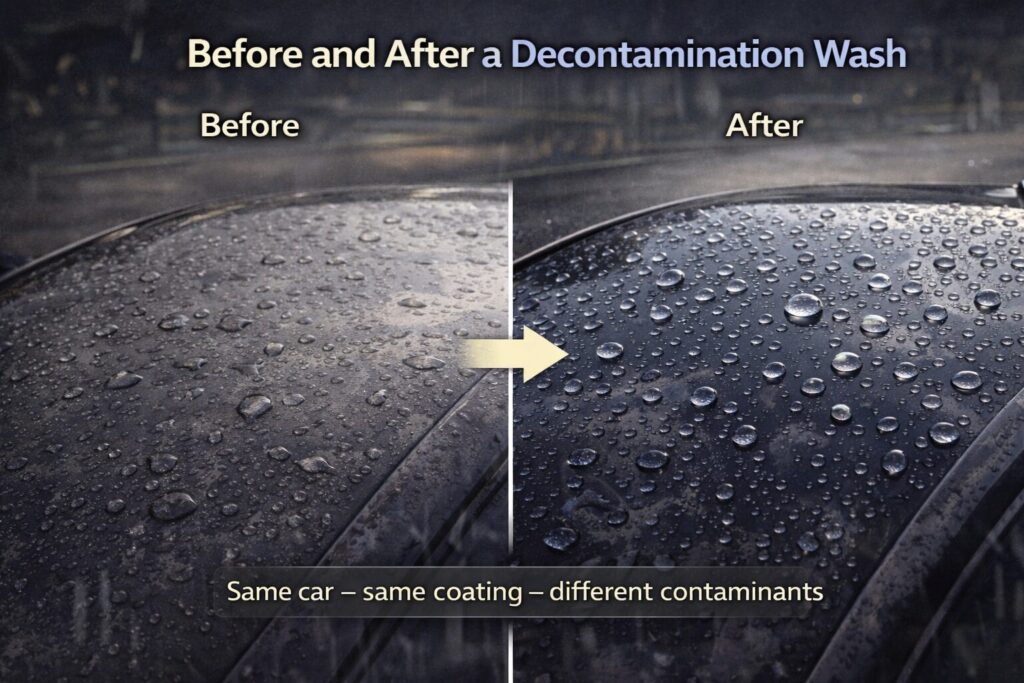
Short Answer: What Is a Decontamination Wash?
A decontamination wash is a deep cleaning process that removes bonded contaminants from the surface of a ceramic-coated car — contaminants that regular washing cannot remove.
It targets:
- mineral deposits
- iron particles and brake dust
- industrial fallout
- traffic film buildup
…without stripping or damaging the ceramic coating.
Think of it as resetting the coating, not replacing it.
Why Regular Washing Sometimes Stops Working
A proper hand wash removes:
- loose dirt
- mud
- organic debris
But over time, ceramic coatings accumulate embedded contamination that bonds to the coating itself.
This is one of the most common misconceptions about ceramic coatings and how they actually fail over time:
👉 Why Ceramic Coating Fails – And Why It Usually Doesn’t Actually Fail
Common sources include:
- rainwater minerals
- hard water spots
- brake dust
- air pollution
- winter road salt residue
Once these contaminants bond to the surface, hydrophobic behavior drops, even though the coating underneath is still intact.
This is why many owners believe their ceramic coating has “failed” – when it hasn’t.
If this sounds familiar, it’s important to understand the difference between failure and contamination:
👉 Signs Your Ceramic Coating Is Contaminated – Not Dead
Signs Your Ceramic Coating Needs Decontamination
You may need a decontamination wash if you notice:
- ❌ Water beads unevenly or stops sheeting
- ❌ Paint feels rough even after washing
- ❌ Drying becomes difficult or streaky
- ❌ Gloss looks muted or flat
- ❌ Water spots return quickly
These are contamination symptoms, not coating failure.
If washing alone no longer improves performance, decontamination is the next logical step.
Decontamination is the “reset button” for your protection. To see how this deep cleaning fits into the overall value of having a coated car in BC, read:
👉 Is Ceramic Coating Worth It in Vancouver – And Does It Need Maintenance?

What Happens During a Decontamination Wash?
A proper decontamination wash is a controlled, multi-step process — not aggressive scrubbing.
1. Safe Pre-Wash & Rinse
Loose debris is removed to prevent scratching during treatment.
2. Chemical Decontamination
Ceramic-safe products are used to dissolve:
- iron particles
- mineral buildup
- bonded grime
This works chemically, not by abrasion.
3. Gentle Mechanical Decontamination (When Needed)
In some cases, very light mechanical decontamination is used — only when safe, and only by professionals who understand ceramic coatings.
4. Final Rinse & Evaluation
Hydrophobic behavior is reassessed after contamination is removed.
In many cases, water beading and slickness return immediately.
Once the coating is clean and beading water again, it must be dried safely to prevent new mineral deposits. Learn the exact process here:
👉 Proper Drying Techniques for High-End Ceramic Coatings
Does Decontamination Damage Ceramic Coatings?
When done correctly — no.
A proper decontamination wash:
- does not strip ceramic coatings
- does not scratch paint
- does not shorten coating lifespan
In fact, it often extends the life of the coating by restoring performance and preventing long-term mineral damage.
Problems usually come from:
- harsh chemicals
- incorrect DIY shortcuts
- aggressive mechanical methods
How Often Does a Ceramic-Coated Car Need Decontamination?
It depends on:
- driving conditions
- weather
- water quality
- wash frequency
General guideline:
- Every 6–12 months for most vehicles
- More often in rainy or hard-water environments
- Less often with frequent professional maintenance
Regular safe washing reduces the need – but does not eliminate it entirely.
For washing fundamentals, start here:
👉 How to Properly Wash a Ceramic-Coated Car (Complete Safe Wash Guide)
Decontamination Wash vs. Regular Wash
| Regular Wash | Decontamination Wash |
|---|---|
| Removes loose dirt | Removes bonded contaminants |
| Performed frequently | Performed periodically |
| Maintains cleanliness | Restores coating performance |
| Cosmetic | Functional |
Both are necessary – they serve different purposes.

Why Decontamination Matters Even More in Rainy Climates
In wet regions:
- rainwater contains minerals and pollutants
- cars stay wet longer
- contamination bonds faster
This makes ceramic coatings appear to fail early, unless they are properly decontaminated.
Without it, coatings can become clogged and ineffective long before their actual lifespan ends.
In wet climates, repeated air-drying after rain or washing accelerates mineral bonding and performance loss:
👉 Why Air-Drying Slowly Kills Ceramic Coating
Final Verdict
Ceramic coating does not eliminate maintenance — it changes how maintenance must be done.
When washing no longer restores performance, a decontamination wash is the next level of proper care.
Done correctly, it:
- restores hydrophobic behavior
- improves gloss and slickness
- extends coating life
- prevents unnecessary re-coating
Ceramic coatings work best when they’re maintained intelligently – not aggressively.
If decontamination restores performance but water spotting keeps returning, the next issue to understand is how water itself damages ceramic coatings over time. This is explained in detail here:
👉 How Water Can Kill Ceramic Coating Faster Than Scratches
Is your ceramic coating losing its performance? Don’t settle for a basic wash – let Jason Rise restore your car’s protection and gloss with a professional decontamination treatment.