 Jason Rise Car Wash
Car Care Knowledge Base
Jason Rise Car Wash
Car Care Knowledge Base
PPF vs. Ceramic Coating: Which One Does Your Car Actually Need in Vancouver?

Buying a new car in Vancouver is a joy that is almost immediately followed by anxiety. The endless rain, winter road salts in Coquitlam, and the inevitable barrage of rocks flying off commercial trucks on Highway 1 can quickly turn a flawless factory clear coat into a battlefield.
This article is part of our Car Care Knowledge Base, where we break down detailing chemistry and help you make informed decisions to preserve your vehicle’s value.
If you are currently asking yourself:
- What will actually protect my paint better: a clear film or a ceramic layer?
- Will a ceramic coating stop rock chips on the highway?
- Why is the dealership pushing a “paint protection package,” and is it a scam?
- How do I combine these services without overpaying?
…this guide will give you the exact answers.
The Short Answer: Film or Ceramic?
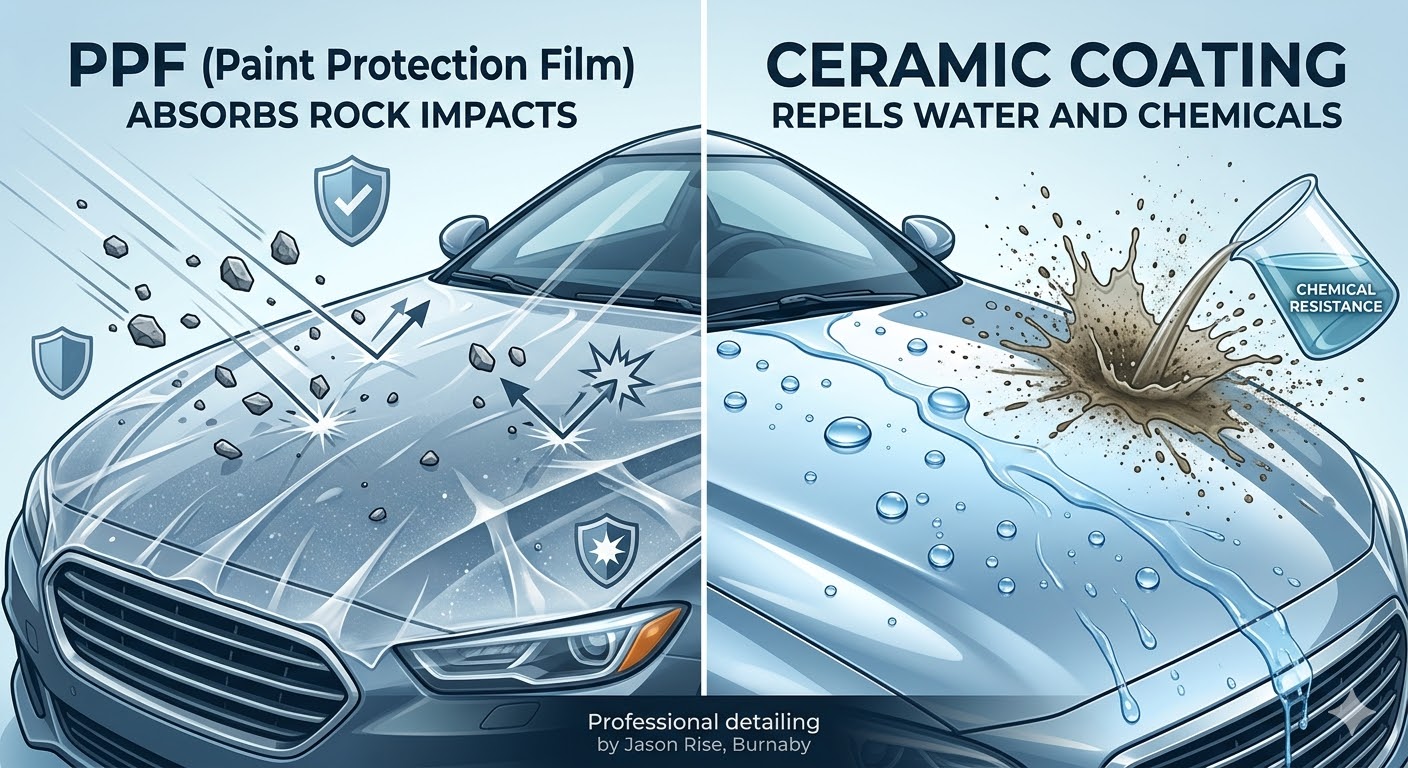
Paint Protection Film (PPF) creates a physical barrier that stops rock chips and deep scratches. Ceramic Coating provides advanced chemical protection, incredible gloss, and makes washing your car effortless. For Vancouver roads, the ultimate strategy is combining both.
Both options share the same ultimate goal: keeping your factory clear coat in pristine condition. However, they achieve this through completely different scientific principles.
What is Paint Protection Film (PPF)?
Paint Protection Film (PPF) is a highly durable, transparent polyurethane film applied directly to the exterior of the vehicle. It acts as a heavy-duty sacrificial layer.
When a rock gets kicked up by a passing car, it acts like a micro-projectile—this is what we call the “sandpaper effect”. Automotive clear coat is simply too brittle to withstand that kind of localized impact and chips away. PPF, however, is elastomeric. It absorbs the kinetic energy of the impact and disperses it, leaving the paint underneath untouched. Most modern high-end films even feature self-healing properties, where minor scratches vanish under heat (like sitting in the sun or using hot water).
What is a Professional Ceramic Coating?
A Ceramic Coating is a liquid polymer (typically composed of Silicon Dioxide, SiO2) that chemically bonds with the factory clear coat, creating a microscopic, yet exceptionally hard, hydrophobic layer.
Let’s be clear: it will not stop rocks or someone dragging a key down your door. Its true superpower is chemical defense. In Vancouver’s wet climate, road spray is packed with corrosive minerals, engine oil, and winter brines. When that water dries on unprotected paint, it chemically etches into the clear coat.
Water can actually cause more long-term damage than minor scratches. Learn how minerals destroy your paint:
PPF vs. Ceramic Coating: The Ultimate Breakdown
1. Cost Comparison
PPF is a significantly more expensive material, and the installation process requires surgical precision and time. Wrapping a full car in PPF can cost several times more than a premium ceramic application. A ceramic coating is a more accessible investment that still provides 100% surface coverage for your vehicle.
2. Maintenance Differences
Neither method creates a magical, maintenance-free forcefield. Ceramic coatings require regular, safe hand washing with pH-neutral shampoos so their microscopic pores don’t get clogged with Traffic Film. PPF also demands safe washing techniques to prevent edge-lifting and long-term yellowing caused by neglected dirt.
Wondering if you should spend money on a coating if you don’t plan to maintain it properly? Read our honest analysis:
The Best Strategy for Vancouver: Combining Both
If you want maximum protection without severely overspending, professional detailers (and our team at Jason Rise) recommend the following hybrid approach:
- PPF on High-Impact Zones: Apply film to the front bumper, hood, front fenders, and side mirrors. These are the areas that take the brunt of highway rock chips and bug splatter.
- Ceramic Coating on the Entire Car: Apply the coating to the rest of the painted surfaces (doors, roof, trunk), and most importantly, over the PPF itself.
Adding a ceramic coating over PPF makes the film incredibly slick, protects it from UV degradation, and ensures that dirt and water bead off uniformly across the entire vehicle. It is the ultimate synergy for paint preservation.
Final Verdict
Do not settle for overpriced and questionable “paint protection packages” at the dealership. Often, dealers apply cheap polymer sealants, market them as premium ceramics, and skip the crucial step of actually correcting the paint beforehand.
👉 Why Paint Correction is Mandatory Before Ceramic Coating
Your vehicle requires a tailored approach. Proper paint protection is an investment that pays daily dividends in how easy your car is to wash, and massive returns when it comes time to sell or trade in the vehicle.